For most small UK shops that want full control, unusual products or a site that doubles as a brand, WooCommerce is the better fit. If you want to sell standard products quickly, with as little technical upkeep as possible, Shopify is often the better pick.
I build online shops on WooCommerce, so I’m not neutral, but I’ll tell you plainly when Shopify is the right call. Here’s how I’d weigh up WooCommerce vs Shopify for a small UK business, with the real 2026 prices.
The short version
Choose Shopify if you sell a straightforward catalogue, want something running fast, and would rather pay a monthly fee than think about hosting, updates or security.
Choose WooCommerce if you want the shop to sit inside a proper website, you need product personalisation or custom workflows, or you want to own the whole thing and avoid being tied to one platform.
Neither is better in every case. The right answer depends on what you sell and how you want to run it.
Where Shopify is the better choice
I’d point you to Shopify in these situations:
- You want to launch quickly. Shopify is a hosted product. Hosting, security and checkout are looked after for you, so there’s less to set up and less to go wrong.
- You sell standard products. If you sell items in sizes and colours and don’t need anything unusual, Shopify handles that well out of the box.
- You don’t want to manage a website. With WooCommerce you’re running WordPress, which needs updates and maintenance. If that sounds like a chore, a hosted platform removes it.
- You plan to sell mainly through the platform’s own tools. Shopify’s built-in selling features are designed around a single, focused shop.
The trade-off is flexibility. You work within what the platform allows, apps add monthly costs, and your shop lives on someone else’s system.
Where WooCommerce is the better choice
WooCommerce runs on WordPress, which means the shop is part of a normal website you control. That matters when:
- The shop is part of a bigger brand site. Blog, editorial content, landing pages and shop all live together with one design.
- You need custom behaviour. Personalised products, bespoke order handling and automated fulfilment are things I can build in rather than bolt on.
- You want to own it. It’s open source, so you’re not locked in to one company’s pricing or rules.
- You care about SEO and content. WordPress gives you full control over page structure, blog content and search setup.
The trade-off is responsibility. Someone needs to look after hosting, updates, security and speed. That’s part of what I handle for clients, and it’s why it’s worth asking any developer what happens after launch.
Two shops I built on WooCommerce
Two projects show where WooCommerce earns its place.
Precious Thoughts is a personalised gifts brand specialising in memorial keepsakes. We built a fully bespoke WooCommerce store that balances warmth with a clean, professional shopping experience. Product personalisation, order management and automated fulfilment workflows were all integrated. That kind of custom behaviour is exactly what a standard hosted template struggles with.
The Unstyled House is built around a brand philosophy: loving your imperfect home rather than chasing the polished Instagram version. The store handles unique individual product listings across five collections, with a full editorial blog, newsletter subscriber integration and a customer account portal, and it was built mobile-first throughout. A shop where the writing and the brand matter as much as the products suits WordPress well.
You can see how I approach this on my eCommerce website design page.
Running costs and ownership
Be wary of anyone who gives you a cost comparison without asking what you sell. Shopify charges a monthly subscription, and extras usually come as paid apps. WooCommerce itself is free, but you pay for hosting, a design, and the upkeep. Which works out cheaper depends on how many features you need and how long you run the shop.
Here are the headline numbers as listed in November 2026, before VAT:
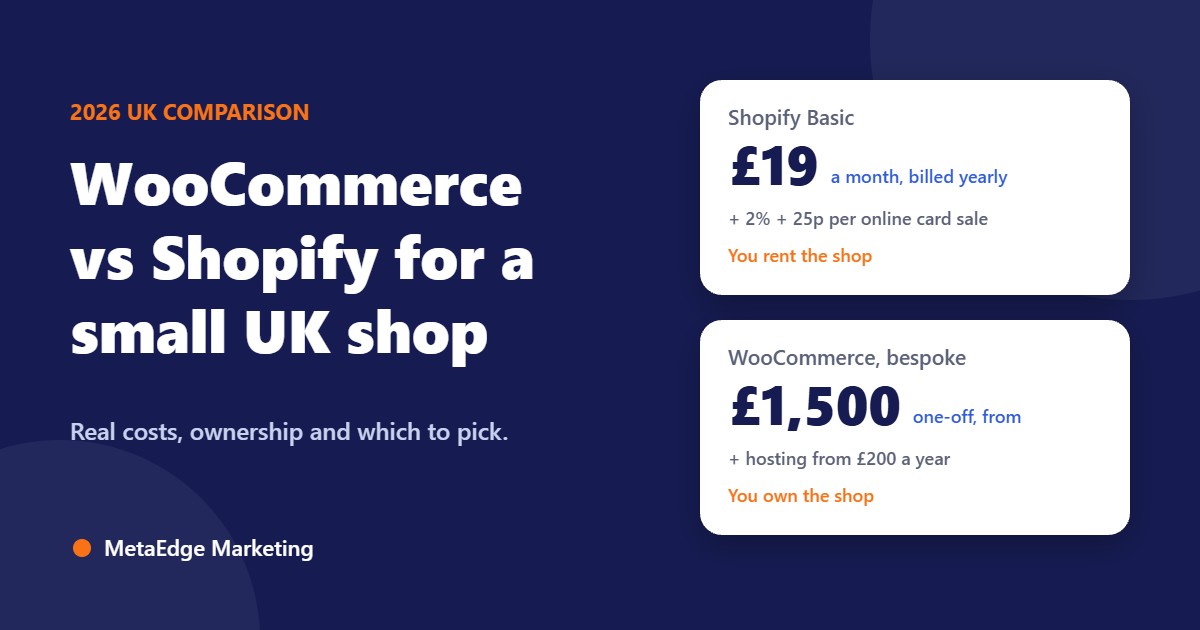
| Shopify Basic | WooCommerce, built by me | |
|---|---|---|
| Upfront | £0 | From £1,500 one-off |
| Platform fee | £19 a month billed yearly, or £25 monthly | £0, WooCommerce is free |
| Hosting | Included | £200 a year, managed by me |
| Online card fees | 2% + 25p a sale with Shopify Payments | Your payment provider’s rate, for example Stripe |
| Extra features | Usually paid monthly apps | Built in, or a one-off plugin |
| Who owns it | You rent the shop | You own the site from day one |
A quick example. Say you sell £2,000 a month online across 40 orders. On Shopify Basic that’s £228 a year in plan fees plus about £600 in card fees, so around £830 a year, every year, before any paid apps. On WooCommerce the card fees through Stripe come to roughly £460 and hosting is £200, so around £660 a year, but you pay for the build upfront. Over three years the gap narrows or flips depending on how many apps you’d need on Shopify, which is why I always ask what you sell first.
What I’d say with confidence is this: check what you own at the end. With WooCommerce on a bespoke build, the site is yours. With a hosted platform, you rent the shop and can’t easily take it elsewhere.
My pricing for a bespoke WooCommerce build starts from £1,500 one-off, and you own everything from day one. The details are on my pricing page.
Speed, SEO and the long game
A slow shop loses sales before the page has even loaded. Both platforms can be fast or slow depending on how they’re built, so don’t pick on a rumour. If you go with WooCommerce, make sure images, plugins and caching are set up properly. My guide to the problems that slow a website down covers the usual causes.
On search, a shop with strong product pages, helpful content and clean structure has a long-term edge. WordPress makes that easy to control. Shopify can do it too, but you’re working inside its structure.
How I’d decide in five minutes
- Do your products need personalisation or unusual rules? Lean WooCommerce.
- Do you want a blog, brand pages and a shop on one site? Lean WooCommerce.
- Do you sell a simple range and want minimal upkeep? Lean Shopify.
- Do you want to launch in days with no technical involvement? Lean Shopify.
- Do you want to own the site outright? Lean WooCommerce.
If your answers split down the middle, talk to someone before you spend money. A free strategy call costs nothing, and I’ll tell you honestly if Shopify is the better fit for what you sell.
FAQ
Is WooCommerce cheaper than Shopify?
It depends. WooCommerce is free software but you pay for hosting, design and upkeep. Shopify charges a subscription plus any paid apps. Compare the full cost over a year, not just the headline fee.
Is Shopify easier for a beginner?
Usually yes, because it’s hosted and the setup is simpler. If you don’t want to think about updates or security, that’s a real advantage.
Can I move from Shopify to WooCommerce later?
Yes, products and customers can be migrated, but it takes planning. It’s easier to choose well first.
Which is better for SEO?
Both can rank well. WooCommerce on WordPress gives more control over structure and content, which is why I prefer it for brands that want to publish useful content alongside their products.